
Is there a winning formula to study effectively? - Part 2
Hanno Schoeman and Villene van der Westhuizen • September 4, 2020
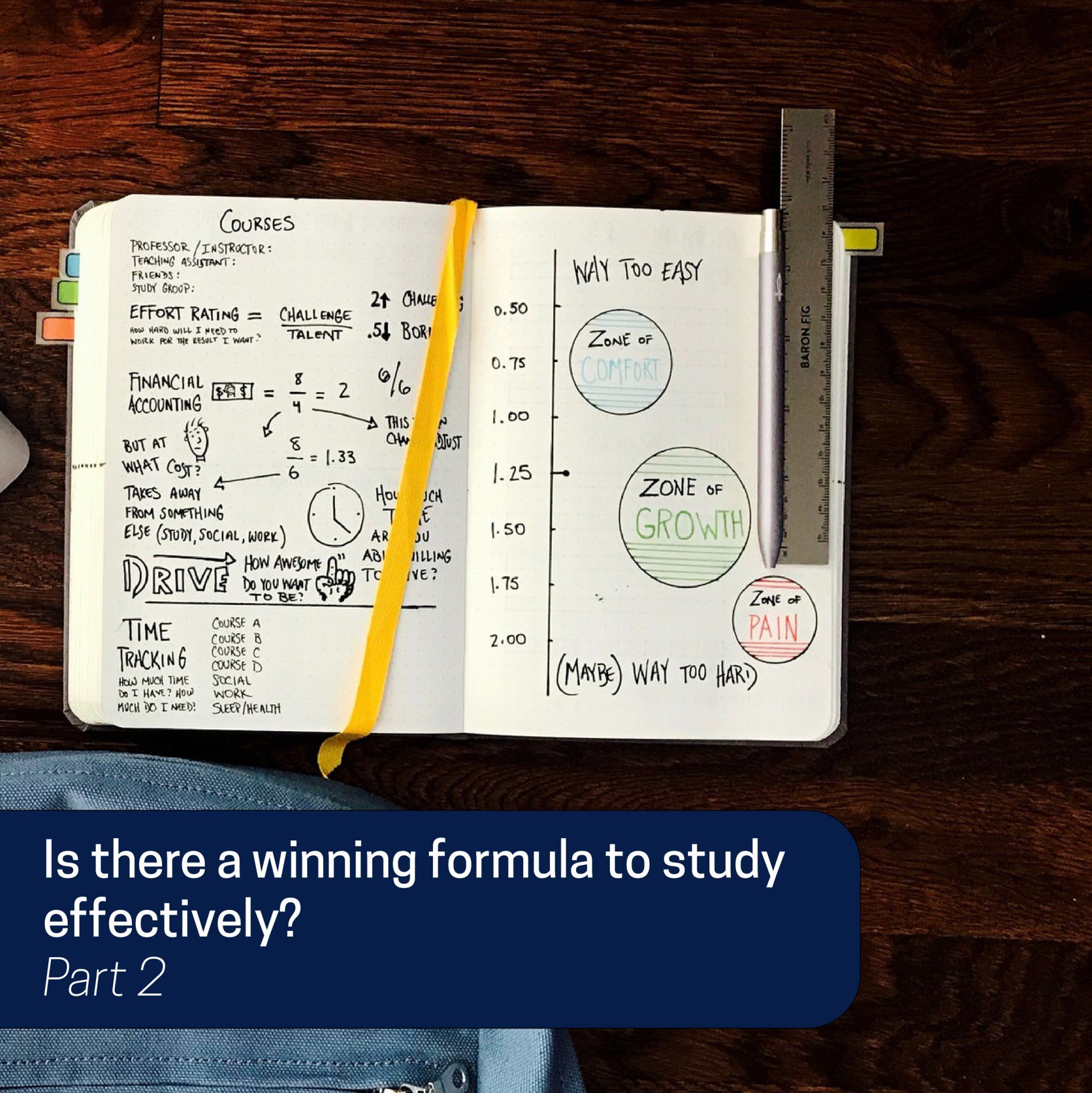
If only students spent half as much time studying, as they thought they were, then almost no student would struggle to achieve higher marks. Improving your marks is not as hard as most students think. It is not about how much time you spend studying and not achieving the desired result. Some students are at the top of their grade without spending hours studying for a subject. What can be done to achieve better results? Study effectively.
Most students think that spending hours studying will help them achieve higher marks. If you go out and investigate this, you will find that numerous students do this and do not necessarily achieve the desired results. Part of this problem with a lot of the students is that even when they say they are “studying” most are not. They most probably are studying whilst talking to friends or watching a movie, to name some examples. So that leaves you questioning whether they are spending that much time studying.
You can spend hours on end studying, but if you are not 100% focused on studying, you are missing the point. It is extremely difficult to switch your focus between different tasks. Some might say that they do achieve results by listening to music and studying, but how do you get your focus back after having discussions with a friend. You need to understand that your brain will choose what it wants more. One can mention multiple examples, but at the end of the day, it is all about focus. In other words, you need to study where and when you do not have any other distractions.
To enable yourself to focus try the following steps.
- You need to be consistent and develop a habit of studying at the same time every day. In other words, you need to train your brain to get focused at the same time every day. It might take some time to get used to it and it will help you from the start of an academic year. It might take you up to three weeks to develop this habit. The best is to study even if you do not have any upcoming tests. Naturally, you need to revise the work you have learnt that day at school in the afternoon.
- You need to study and learn to work faster with more accuracy. You need to keep your brain interested in what you are doing. You can for example make flashcards and try to get through them as fast and as accurately as possible. It will also help if you work on studying from the first day of school. By doing this you break the work down into more manageable pieces to study. By the time you write exams or a test you will be fully prepared for all your subjects and it will take less time to revise your work.
- It is important to study somewhere where there aren’t any distractions. Your bedroom isn’t always the best place to study since you might have a few things that might distract you. If you have a study in your house this might be an ideal place to study. Most people do not have this luxury and it might work if you remove anything in your bedroom that might distract you. It is also important to switch off every distraction, for example, your computer or cellphone.
- The last important thing is to study with questions. This all depends on the subject you are studying. An effective way is to set yourself a hard to answer questions and answer them. It will be ideal if it is a broad question that covers a variety of aspects.
By making the above mention guidelines an everyday habit, you should be able to improve your results. Getting focused and prepared for studying is important but it must not be something that you should stress about.
To learn more tips from our teachers and educational experts, click here.
To learn more about Abbotts College, click here.
To learn about the Abbotts College experience, click here.
Feel free to call or email
one of our correspondents.

Prepare effectively for IEB matric exams with subject-specific study strategies for Maths, English, Sciences & Humanities. A practical guide for Grade 12s.

Wondering what an alternative high school day really looks like? Discover the structure, relationships & student experience that make it different.

Do alternative schools deliver strong academic results? An honest comparison of outcomes between independent and mainstream schools and what the data shows.

Not sure how to compare private schools? Use this practical evaluation guide to assess quality, culture, academics, and value before you commit.
Not sure how the IEB exam system works? Discover what the IEB assesses, how results are calculated, and what it means for your child’s future in plain, simple terms.

Not sure how to guide your teen through career planning? Get practical tips on strengths, subject choices & career paths after matric.
Discover how small class sizes benefit students academically, emotionally and socially. Learn why class size is one of the most important factors when choosing a school

Weighing up private vs public school in South Africa? Explore the honest differences in curriculum, fees, class size and outcomes to make the best choice for your child

Our complete 2026 guide covers curricula, fees, school culture, campus visits, applications, and everything parents need to make the right choice for their child.

Wondering whether the IEB or NSC is better for your child? Our 2026 guide breaks down the key differences in curriculum, assessment, university recognition, and outcomes so you can make the right call.