No 4 - Smart Ways to Improve Your Verbal Study Style
Nikki Clarke • June 11, 2020
Can you remember things more easily if you write down information using your own words?
Do you enjoy reading about and discussing topics that you are studying?
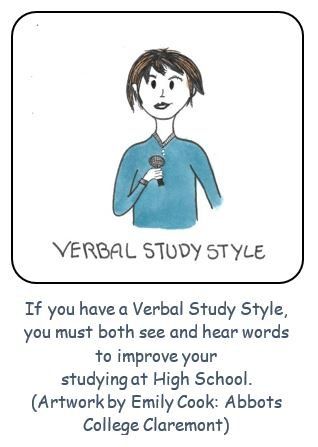
A student with a Verbal Study Style learns best when reading, writing and speaking. If you are verbal learner, these five study strategies will help you improve your studying at High School.
1
Read out loud when you study
As a verbal learner it is important that you both see and hear words when you study. For this reason, reading your work out loud is particularly helpful. The dual action of speaking and hearing yourself has been shown to be a more effective way of remembering information than either silently reading work or listening to a recording of the content. Read this article
to find out more about how reading information out loud to yourself improves your ability to remember content.
2
Restate or script your lessons or notes
It is extremely helpful for a verbal learner to rework their lessons or notes using different words and sentence structures. When you restate information in your own words, you fix it in your mind because you have now put it in a style of language that makes sense to you.
Scripting is when you rework the information into a story. Our brains love stories and find them far more entertaining and memorable than lists of facts. As a verbal learner, you have the language skills to take information and transform it into an entertaining story. The following YouTube video by Story Greenlight identifies three tips on how to write good stories.
3
Read around a topic
Reading around a topic will help you to get to know the subject on a deeper level so that you are not dependent on simply learning the facts. The wider and richer your knowledge on the topic, and the more background information you have, the easier it will be for you to remember the content without having to “study” it.
The best way to read around a topic is to read up online, particularly looking at recent news and journal articles. Always check the date of the web page or when the article was written to make sure you are not reading out-of-date material. And remember, you can ask your teacher to recommend suitable websites, articles, or books for you to read.
4
Create a personal dictionary of important terms and concepts
Knowing the meaning of words and using terminology correctly to describe concepts is important to a student with a Verbal Study Style. You may therefore find it helpful to create a personal dictionary or glossary of terms, concepts, and words that you want to remember. Here is a template that you may want to copy.
| Term | Definition | Synonym | Antonym |
|---|---|---|---|
| Symmetry | When a shape can be divided into two or more identical, mirrored parts (usually around an axis). | uniformity | asymmetry |
| When two shapes are identical after a flip, slide or turn. | equilibrium |
5
Form a Question and Answer study group
Invite like-minded verbal learners to form a study group with the specific aim of asking significant questions on difficult topics so that you can come up with model answers.
You may want to follow this methodology:
• Pose a critical question.
• Invite the group to suggest ideas on how best to answer the question.
• Now ask each other probing questions about the suggested answers, including the simple question, “Why?” and “Are there any other possible answers?”.
• Refine your answer by asking additional questions until you all agree that you have created a model answer.
• Write down the question and the well-formulated, well-considered answer.
If you have a Verbal Study Style, try out these five study strategies and adapt them so that they work best for you. These study strategies will make learning easier, more fun and improve your studying at High School.


Trying to decide between a gap year and university after matric? Compare the pros, cons and alternative pathways to help you choose with confidence.
Wondering what to ask on a school tour? Discover the key questions every parent should ask at a school open day to find the right fit.

Active listening, honest conversations and healthy parental role modelling can help teenagers feel safe enough to speak openly about their mental health.

Bringing more than 21 years of educational experience to Randburg, Marion Kohler is building a school where students are known, supported and inspired to achieve their potential.

Abbotts High School Bordeaux will open its doors to Grade 8 and Grade 9 students, offering an exciting educational experience where individuality is celebrated, academic ambition is encouraged and every student is known.

Prepare effectively for IEB matric exams with subject-specific study strategies for Maths, English, Sciences & Humanities. A practical guide for Grade 12s.

Wondering what an alternative high school day really looks like? Discover the structure, relationships & student experience that make it different.

Do alternative schools deliver strong academic results? An honest comparison of outcomes between independent and mainstream schools and what the data shows.

Not sure how to compare private schools? Use this practical evaluation guide to assess quality, culture, academics, and value before you commit.

Not sure how the IEB exam system works? Discover what the IEB assesses, how results are calculated, and what it means for your child’s future in plain, simple terms.