
No 3 - Five Smart Ways to Improve Your Aural Study Style
Nikki Clarke • May 13, 2020
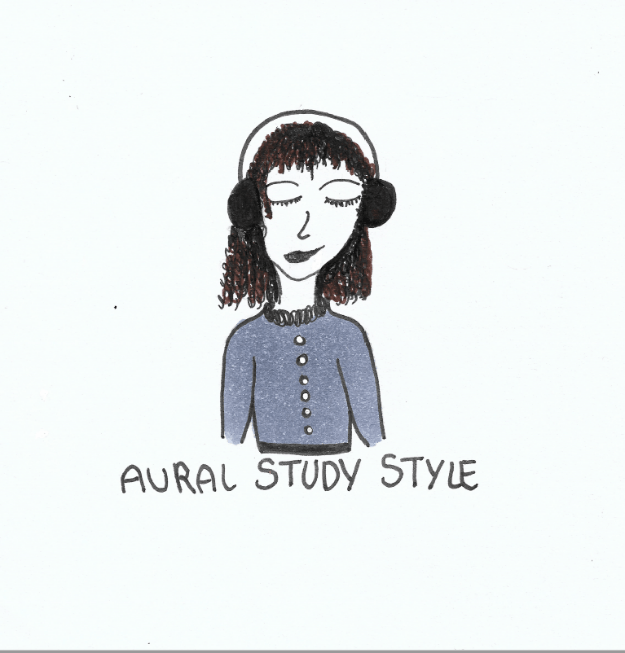
Do you understand information best when you hear it? As a student with an Aural Study Style you prefer to listen and speak to improve your studying at High School.
Can you remember things more easily if you read them out loud?
Do you enjoy participating in class discussions?
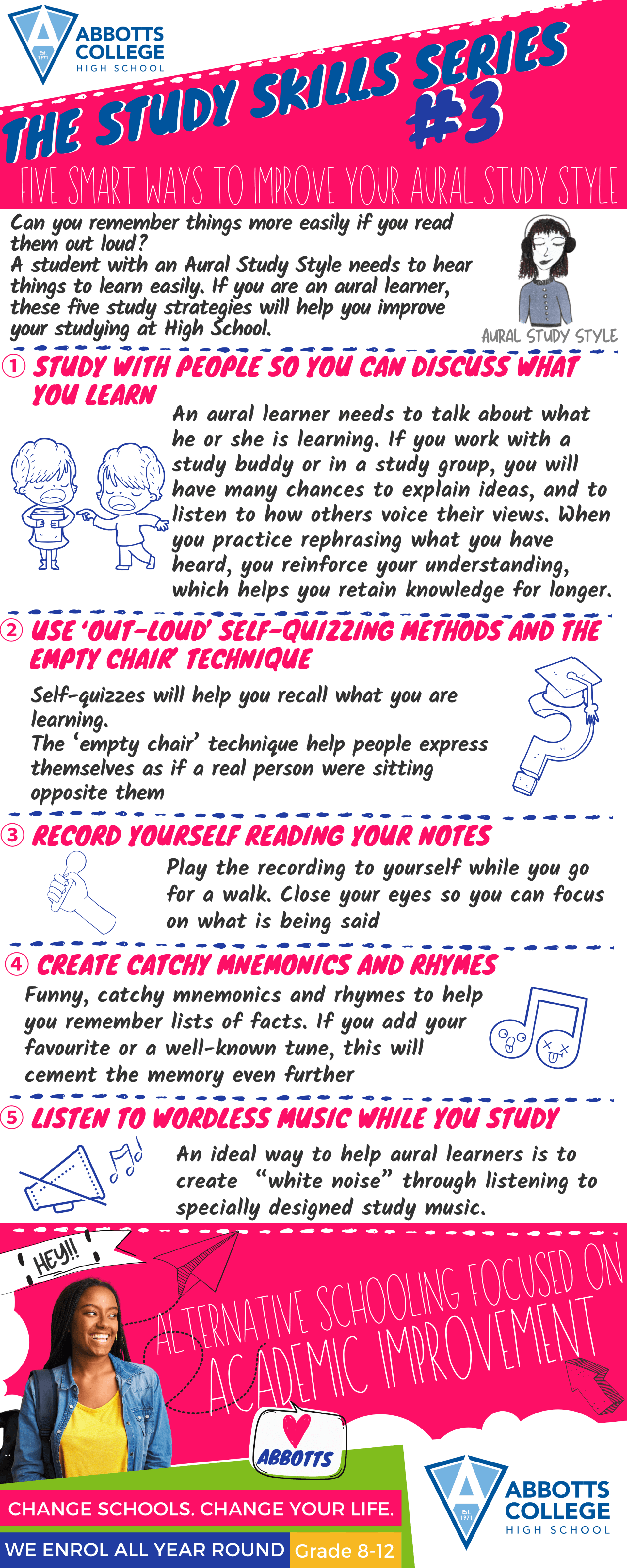
A student with an Aural Study Style needs to hear things to learn easily. If you are an aural learner, these five study strategies will help you improve your studying at High School.
1
Study with people so you can discuss what you learn
An aural learner needs to talk about what he or she is learning. If you work with a study buddy or in a study group, you will have many chances to explain ideas, and to listen to how others voice their views. When you practice rephrasing what you have heard, you reinforce your understanding, which helps you retain knowledge for longer.
Studying in a group also allows you to ask people questions. If you then take it in turns to answer the question, you will hear the material again and again. For an aural learner, hearing this material said over and over is a valuable way of building a memory pathway.
2
Use ‘out-loud’ self-quizzing methods and the ‘empty chair’ technique
Self-quizzes will help you recall what you are learning, particularly if you test yourself ‘out loud’. Ask yourself questions and answer yourself audibly so that you can listen to your answer.
The ‘empty chair’ technique is a method used in psychology to help people express themselves as if a real person were sitting opposite them. You can adapt this method to help you study out loud. Imagine a friend or your teacher is sitting on the “empty chair”. Explain to them or teach them your work.
3
Record yourself reading your notes
Most smartphones allow you to record yourself speaking, which is ideal for aural learners. Record yourself reading your notes, defining key terms, and listing important facts. You can also record yourself reading your setwork book or poetry out loud.
- Play the recording to yourself while you go for a walk.
- Close your eyes so you can focus on what is being said. Listen to the recording and then repeat back what you have heard.
- Listen to the recording while you are doing mundane tasks like getting dressed or tidying your room.
If you have an Aural Study Style, you must hear information to improve your studying at High School.
4
Create catchy mnemonics and rhymes
Aural learners respond well to funny, catchy mnemonics and rhymes to help you remember lists of facts. If you add your favourite or a well-known tune, this will cement the memory even further. Read this blog to find out more about different types of mnemonics you can use to help you. Some well-used mnemonics are:
- MRS NERG (7 characteristics of Life – Biology)
- PEPE (4 types of Rivers – Permanent, Episodic, Periodic, Exotic)
- Risk In Life Is Real (5 factors to consider when making investment decisions: Risk level, Investment Period, Liquidity, Inflation Rate, Return on Investment)
- MAIN (4 causes of World War I: Militarism, Alliance System, Imperialism, Nationalism)
5
Listen to wordless music while you study
Aural learners are often distracted both by silence and by noise. If it is too quiet, auditory learners find themselves overwhelmed. If it is too noisy, then aural learners become interested in what is going on around them. An ideal way to help aural learners is to create what is known as “white noise” through listening to specially designed study music. This music helps to block out noise. It does not distract you from your work. Some people suggest that it can even enhance your ability to focus. Why not try listening to this recording while you study to see if it helps you?
If you enjoy this music, consider subscribing to this free South African You Tube Channel that produces lyric-free, relaxing music.
Relaxing Music
If you have an Aural Study Style, try out these five study strategies and adapt them so that they work best for you. These study strategies will make learning easier, more fun and improve your studying at High School.
References
https://wordcounter.net/blog/2016/10/24/102568_what-are-mnemonics.html
https://www.youtube.com/watch?v=Q2HDJP10qSQ
https://www.youtube.com/watch?v=5LXhPbmoHmU&t=30s

Trying to decide between a gap year and university after matric? Compare the pros, cons and alternative pathways to help you choose with confidence.
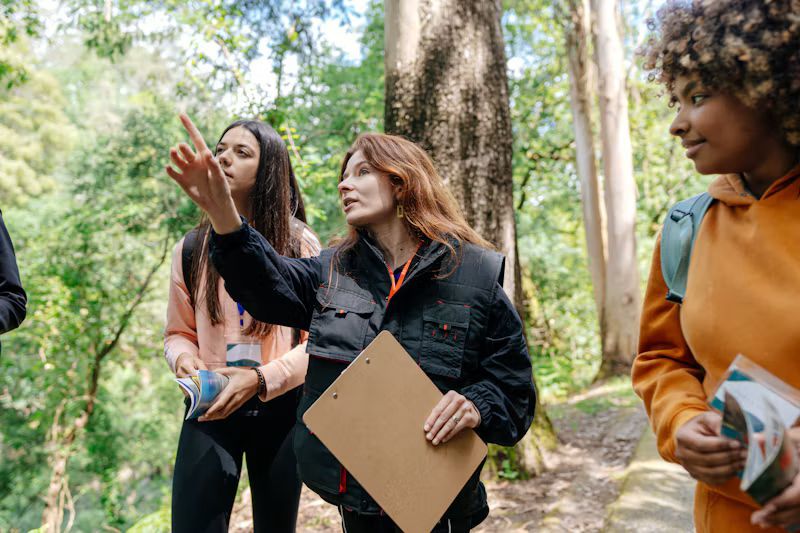
Wondering what to ask on a school tour? Discover the key questions every parent should ask at a school open day to find the right fit.

Active listening, honest conversations and healthy parental role modelling can help teenagers feel safe enough to speak openly about their mental health.

Bringing more than 21 years of educational experience to Randburg, Marion Kohler is building a school where students are known, supported and inspired to achieve their potential.

Abbotts High School Bordeaux will open its doors to Grade 8 and Grade 9 students, offering an exciting educational experience where individuality is celebrated, academic ambition is encouraged and every student is known.

Prepare effectively for IEB matric exams with subject-specific study strategies for Maths, English, Sciences & Humanities. A practical guide for Grade 12s.

Wondering what an alternative high school day really looks like? Discover the structure, relationships & student experience that make it different.

Do alternative schools deliver strong academic results? An honest comparison of outcomes between independent and mainstream schools and what the data shows.

Not sure how to compare private schools? Use this practical evaluation guide to assess quality, culture, academics, and value before you commit.

Not sure how the IEB exam system works? Discover what the IEB assesses, how results are calculated, and what it means for your child’s future in plain, simple terms.