
Five Smart Ways to Improve Your Social Study Style
Nikki Clarke • April 15, 2021
Do you communicate well with people? Do you learn more easily when interacting with others? As a student with a Social Study Style you need to share ideas to improve your studying at High School.

Can you remember things more easily if you participate in a group discussion?
Do you find it helps to bounce ideas off other people and listen to their feedback?
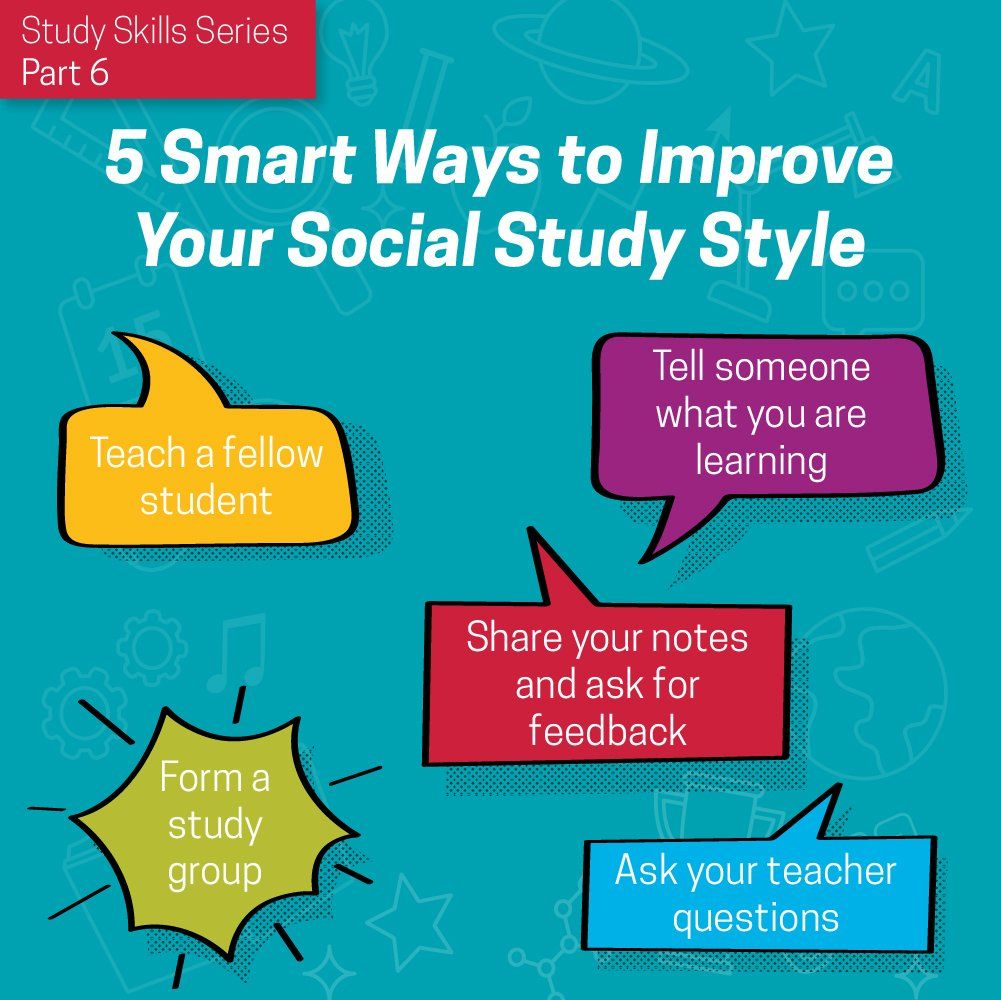
A student with a Social Study Style learns best when communicating and engaging with other people. If you are a social learner, these five study strategies will help you improve your studying at High School.
1. Form a study group
You learn best when you are with other people so form a face-to-face or a virtual study group that meets regularly to review and revise the work you are learning. You can ask your teacher which topics to prioritise and select these for discussion. Because you are stimulated by dialogue, you concentrate more keenly and are therefore able to remember the information better when discussing it with others. When you share your understanding of a topic out loud to others, it improves your understanding and thus ability to remember it. And, as you are a sensitive listener, you can reflect on other people’s contributions, which further improves your understanding. Because of this, this style of collaborative learning helps you to remember information more easily.
Read this article from wikiHow on how to form and establish a study group to get great tips on recruiting members, structuring your study group and conducting the study sessions.
2. Ask your teacher questions
When you must study on your own, always have a page ready to write down questions that you can ask your teacher the next day. Formulating the questions will help you to organise your thoughts and make the process of studying on your own feel less lonely. When you discuss your questions with your teacher the next day, both your understanding of the topic will be deepened and the memory of the work you studied increased.
It is also important that you ask your teacher questions during lessons especially if you do not understand something or if you want to know more information about the topic. It is often important to a social learner to find out how the topic can be applied in the real world and how it can be used to help people. You need to interact with your teacher and fellow students during the lesson so that the work you are learning is retained.
3. Tell someone what you are learning
Ask a parent, grandparent, older sibling, or set up a study buddy who will set aside some time every day to listen to what you have been learning. Telling someone what you have learned helps to strengthen the memory pathway. As a social learner, it is also one of the most enjoyable ways of revising.
Before tests and exams, you may wish to ask this person if they would be willing to ask you questions or test you on the work you have learned. This might be especially important if you are feeling tired as you will then need the energy boost you get from being with someone to help you to continue working.
4. Share your notes and ask for feedback
As a co-operative learner, you know how important feedback is if you want to improve. You also like it when everybody benefits, and so sharing your notes and comparing your work with others is an excellent way to ensure everyone has the best quality information to study from. By reviewing each other’s notes, comparing them, and deciding what to include in the final copy, you will also start the process of learning the work. Remember, sharing your notes does not simply mean lending your notes to someone so that they copy them. It is a collaborative exercise in which you all try to reach consensus to establish the best resource possible.
5. Teach a fellow student
One of the most effective ways to study is to teach someone else. As a people-person, you have strong verbal and non-verbal skills, and your empathy for others makes you an ideal mentor and teacher. Explaining topics and concepts to another person is an excellent way to make sure that you really understand the work, and because you quite often have to repeat difficult sections, you will soon find that you have the work memorised. In fact, studies have shown that teaching is a much more effective way of learning than simply studying. So, not only will you be benefitting your fellow student, but you will gain tremendously.
If you have a Social Study Style, try out these five study strategies and adapt them so that they work best for you. These study strategies will make learning easier, more fun and improve your studying at High School.
https://www.wikihow.com/Form-a-Study-Group/
https://getatomi.com/blog/should-i-share-study-notes/
https://digest.bps.org.uk/2018/05/04/learning-by-teaching-others-is-extremely-effective-a-new-study-tested-a-key-reason-why/

Prepare effectively for IEB matric exams with subject-specific study strategies for Maths, English, Sciences & Humanities. A practical guide for Grade 12s.

Wondering what an alternative high school day really looks like? Discover the structure, relationships & student experience that make it different.

Do alternative schools deliver strong academic results? An honest comparison of outcomes between independent and mainstream schools and what the data shows.

Not sure how to compare private schools? Use this practical evaluation guide to assess quality, culture, academics, and value before you commit.

Not sure how the IEB exam system works? Discover what the IEB assesses, how results are calculated, and what it means for your child’s future in plain, simple terms.

Not sure how to guide your teen through career planning? Get practical tips on strengths, subject choices & career paths after matric.

Discover how small class sizes benefit students academically, emotionally and socially. Learn why class size is one of the most important factors when choosing a school

Weighing up private vs public school in South Africa? Explore the honest differences in curriculum, fees, class size and outcomes to make the best choice for your child

Our complete 2026 guide covers curricula, fees, school culture, campus visits, applications, and everything parents need to make the right choice for their child.

Wondering whether the IEB or NSC is better for your child? Our 2026 guide breaks down the key differences in curriculum, assessment, university recognition, and outcomes so you can make the right call.